
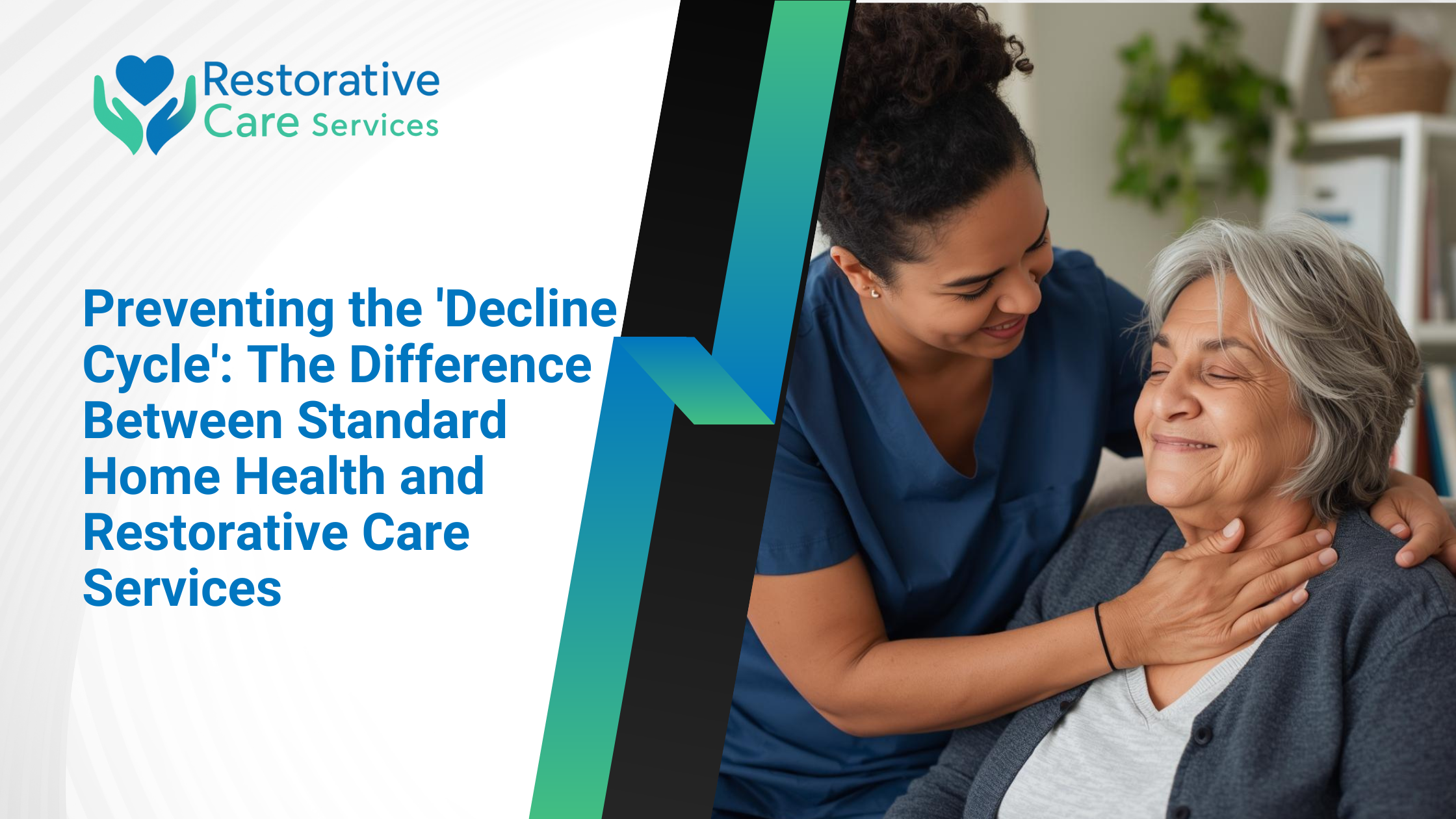
You know the feeling. We hear it from families in Jacksonville every single week.
A parent falls. Or maybe they have a knee replacement. They spend two weeks in a rehab facility. They work hard. They walk down the hall. They feel strong.
Then the insurance company says time is up. They get discharged.
They come home to their favorite chair. And they sit.
It starts slowly. First, they stop walking to the mailbox because it is hot outside. Then they stop getting their own water because it is easier to ask you for it. Within a month, the progress they made in rehab is gone.
We call this the Decline Cycle. It is not inevitable. It is not just part of getting old. It happens because of a gap in our healthcare system.
Most people think hiring any caregiver will fix this. But there is a massive difference between standard home health and Restorative Care Services. One focuses on comfort. The other focuses on keeping you independent.
Understanding this difference is the only way to stop the slide.
Why the Decline Cycle Happens After Rehab
To fix the problem, you have to understand the biology. The human body is efficient. If you do not use a muscle, the body stops maintaining it.
When a senior leaves a structured rehab environment, they lose their daily push. In rehab, nurses and therapists are there to make them move. At home, well-meaning family members often do the opposite. You love them. You want them to rest. So you bring them lunch. You tie their shoes. You do the laundry.
This kindness actually accelerates the decline.
When we do everything for a senior, we rob them of the physical activity needed to maintain their strength. This is where restorative care changes the game. It is not about letting them struggle. It is about helping them succeed on their own.
The Core Difference: Doing For vs. Doing With
Standard home health is usually task-oriented. It is about checking boxes. Did the patient eat? Is the patient clean? Is the house tidy?
Restorative Care Services operates on a different philosophy. The goal is function.
Think about a simple task like putting on a shirt.
In a standard care model, the caregiver puts the shirt on the senior. It is fast. It is efficient. But the senior is passive.
In a restorative model, the caregiver hands the shirt to the senior. They might support the elbow or guide the arm, but the senior does the lifting. It takes longer. It requires patience. But that movement is a shoulder exercise. It maintains range of motion. It keeps the brain connected to the muscles.
This philosophy applies to everything. It applies to cooking. It applies to walking to the bathroom. Every interaction is a chance to get stronger.
Post Surgical Assistance: The Critical First Month
The transition home is the most dangerous time for recovery. This is especially true after orthopedic surgeries.
Post Surgical Assistance is about more than just changing bandages. It is about conquering fear. The hospital floors were flat and shiny. The floors in a historic San Marco home are not. There are rugs. There are thresholds. There are stairs.
Fear of falling is the number one reason seniors stop moving after surgery.
A restorative approach addresses this fear directly. We do not just tell them to be careful. We walk with them. We teach them how to navigate their specific living room. We practice getting in and out of their specific bed.
This builds confidence. And confidence is what keeps people moving when the caregiver is not there.
Managing Long-Term Conditions with Physical Disability Support
For families managing chronic conditions like Parkinson’s or stroke recovery, the goal shifts. It is not always about getting better. Sometimes it is about not getting worse.
This is where Physical Disability Support becomes vital.
Without consistent movement, joints stiffen up. Muscles atrophy. This can happen in weeks. A restorative plan includes daily range-of-motion exercises. These are not intense gym workouts. They are gentle movements designed to keep the joints lubricated and flexible.
It is about maintenance. If we can keep the hips loose, walking remains possible. If we can keep the fingers flexible, feeding yourself remains possible. These small victories add up to a massive difference in quality of life over a year.
Transportation is Therapy
We often forget that driving is a physical and cognitive task. When a senior has to give up the keys, their world shrinks.
Isolation is a fast track to physical decline. If you cannot get to the grocery store, you eat worse food. If you cannot get to the park, you get less fresh air.
Reliable Transportation is a key part of staying healthy. But for someone with mobility issues, a ride share app is not enough. They cannot sprint to the curb.
Our approach to transportation is door-through-door. We help lock the house. We help navigate the driveway. We handle the parking at Baptist Medical Center or the Mayo Clinic.
This access allows the senior to stay engaged with their community. It means they can attend their follow-up appointments without anxiety. It means they can see friends. Social engagement is a powerful motivator for physical health.
Redefining Personal Care
Most people treat Personal Care as a hygiene task. We treat it as a health check.
When we assist with bathing or dressing, we are doing a medical observation. We check for skin breakdown. We look for new bruises that might indicate a stumble the senior forgot to mention.
We also use personal care to promote autonomy.
If a senior can wash their own face, they should. If they can button their own shirt, they should. Even if it takes five minutes. That fumbling with buttons is fine motor skill practice. It keeps the fingers nimble.
By incorporating these small challenges into the daily routine, In-home Care becomes a therapy session that lasts all day.
The Mental Game: Companion Care
You cannot separate the body from the mind. Depression is heavy. It makes your limbs feel heavy.
A senior who is lonely is less likely to do their exercises. They are less likely to get out of the chair.
Companion Care provides the spark needed to get moving. It is easier to walk around the block if you have someone to talk to. It is easier to cook a healthy meal if you have someone to eat it with.
We find that clients who use companion services stick to their restorative routines better. The social connection lifts the mood. And a better mood leads to more movement.
A Plan for Independence
Aging in Jacksonville comes with its own challenges. The heat. The traffic. The distance between neighborhoods.
But with the right support, aging in place is possible.
The Decline Cycle is common. But it is not a requirement. By choosing a care model that focuses on activity rather than passivity, you change the trajectory.
Restorative Care Services offers a different path. We focus on what your loved one can still do. We build on it. We protect it.
If you are worried that your loved one is losing ground after a hospital stay, look closer at your options. Standard care might keep them comfortable. But restorative care keeps them capable.
It is about dignity. It is about autonomy. And it is about making sure that coming home is a step forward, not a step back.
If you want to understand how a restorative plan would work for your specific situation, we are here to help you map it out.
Contact us to learn more about keeping your loved one active and independent.